
From continuous improvement to dynamic renewal: why should companies learn to think in terms of Blue Ocean?
In many industries, growth is becoming increasingly difficult. Markets are saturated, margins are shrinking, and competition is turning into a constant battle over prices, deadlines, market share, and more. The problem is that this type of competition often ends up exhausting teams and undermining results.
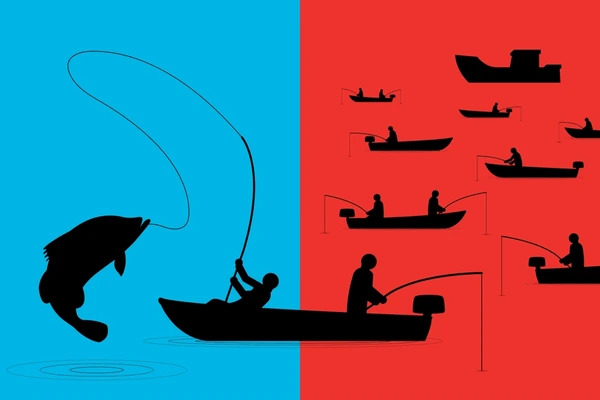
This is precisely what is known as a red ocean: an environment where the rules of the game are already established, and where companies compete on the same criteria, with increasingly similar offerings.
However, there is another strategic approach: thinking in terms of Blue Ocean.
Red Ocean vs Blue Ocean: a difference in approach
In a red ocean, the company seeks to:
- surpass the competition,
- capture existing customers,
- compete on incremental improvements.
In a blue ocean, the company seeks instead to:
- create new strategic spaces,
- attract non-customers,
- Break the value-cost compromise,
- Offer a truly new utility.
The change is therefore profound: it is not about ‘doing better’, it is about doing things differently.
Why continuous improvement is no longer enough
Many companies have made continuous improvement part of their culture. This is positive: it allows them to optimise, reduce waste, and improve quality and performance.
But in some cases, this approach reaches a ceiling. We improve again and again, but we remain locked into the same strategic framework.
At this stage, the risk is to become what some models call a ‘sedentary’ or a ‘migrator’:
- the sedentary imitates, with little prospect of growth,
- the migrator improves, but without exploiting its full potential.
The transition to ‘pioneer’ status therefore requires a different approach: dynamic renewal.
Dynamic renewal: a sustainable advantage
Dynamic renewal consists of combining:
- operational excellence (core business),
- and the ability to create new markets or new demand.
This involves working simultaneously on:
- strategy,
- human skills,
- methods,
- execution.
It is not an ‘idea’, it is a discipline.
The winning trio: Perspective – Team – Roadmap
Organisations that succeed in creating blue oceans often rely on three pillars :
- A clear perspective: where are we going, and why?
- A committed team: capable of driving change, even in the face of uncertainty.
- A structured roadmap: to transform a vision into an action plan.
This triptych is essential because innovation is not solely technological. It is often:
- organisational,
- methodological,
The human factor: the most underestimated element
Most transformations fail not because the tools are bad, but because:
- there is no trust,
- teams do not understand the meaning,
- critical behaviours are not aligned.
The Blue Ocean strategy is therefore not just a method. It is also a mindset: Starting Smart, Scaling Fast.
Conclusion
In an increasingly unstable industrial and economic world, the real question is no longer:
‘How can we be better than the competition?’
but rather:
‘How can we make the competition less relevant?’
Moving from continuous improvement to dynamic renewal means accepting to broaden your horizons, reshape your industry, and open up a new value-cost frontier.